
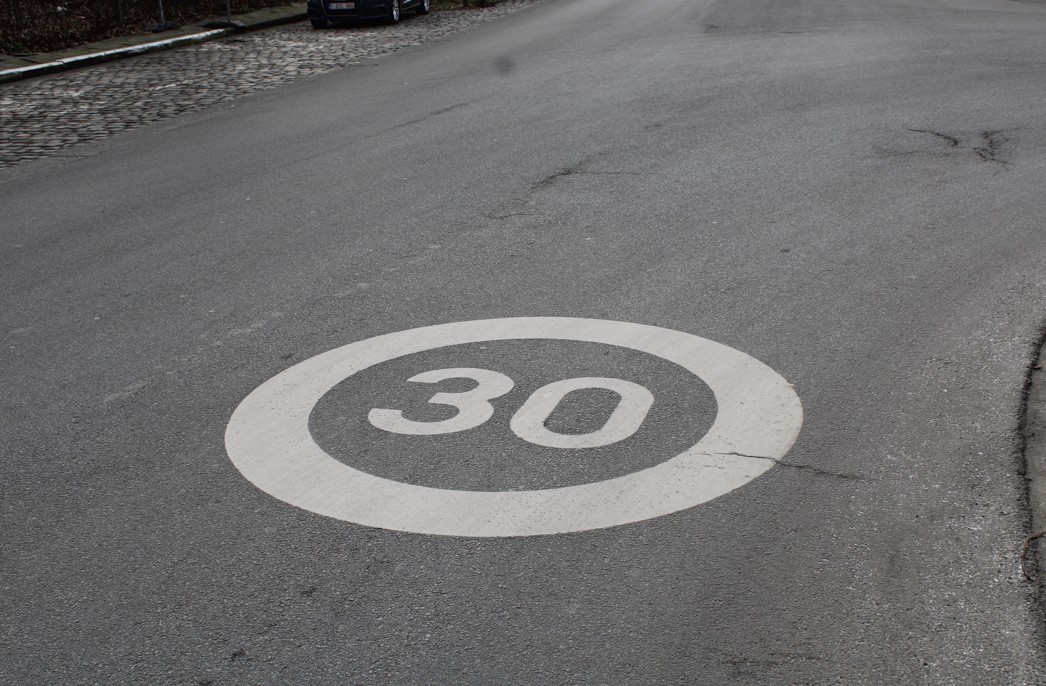
Speed limits are among the most frequently tested parts of the theory test for driving licence B — and among the sections where the most common mistakes are made. Not because the basic rules are difficult, but because candidates do not know the regional differences, exceptions and the crucial difference between maximum speed and adjusted speed well enough.
In this article you will get a complete and fact-checked overview of all speed limits in Belgium in 2026, including the differences between the regions, all special zones and a systematic approach to speed questions on the test.
Overview: speed limits in Belgium by region (2026)
Speed limits in Belgium are partly federal and partly determined by the regions. That makes it more complex than in most neighbouring countries. Here is the full overview:
Road type | Flanders | Wallonia | Brussels |
Within built-up areas | 50 km/h | 50 km/h | 30 km/h (standard) |
Outside built-up areas | 70 km/h | 90 km/h | 70 km/h |
Motorway | 120 km/h | 120 km/h | 120 km/h |
Zone 30 | 30 km/h | 30 km/h | 30 km/h |
Home zone | 20 km/h | 20 km/h | 20 km/h |
School zone (zone) | 30 km/h | 30 km/h | 30 km/h |
Source: Veiligverkeer.be, VAB Magazine, wegcode.be
Speed limits by road type: the details
1. Within built-up areas
In Flanders and Wallonia, the standard within built-up areas is 50 km/h. In Brussels, the region has introduced a general limit of 30 km/h for the entire city — unless signs allow a higher speed.
Exceptions that exam questions deliberately test:
• Zone 30: 30 km/h, indicated by a zone sign — applies until the 'end of zone' sign
• Home zone: maximum 20 km/h — indicated by the F12a sign (blue background with playing children)
• School zone: 30 km/h when the zone sign is present or the dynamic sign is active
• Cycle street: you may not overtake cyclists — your speed may never be higher than that of the cyclist in front of you
2. Outside built-up areas
This is where the biggest region-specific source of confusion lies in the theory test for driving licence B:
• Flanders: 70 km/h on ordinary roads outside built-up areas
• Wallonia: 90 km/h on ordinary roads outside built-up areas
• Brussels: 70 km/h outside built-up areas
On roads outside built-up areas where the traffic directions are separated by road markings (but without a physical central reservation), 70 km/h applies in Flanders and Brussels, 90 km/h in Wallonia. Always pay attention to traffic signs — they take precedence over the standard rule.
3. Motorways
On motorways throughout Belgium, a maximum speed of 120 km/h applies to passenger cars. A minimum speed of 70 km/h also applies on motorways and dual carriageways, unless conditions do not allow it.
• Roadworks: temporary signs lower the limit — these override the standard 120 km/h
• Dynamic signs: digital signs can temporarily adjust the limit in traffic jams or bad weather
• Brussels Ring Road (Flemish side): large sections with a maximum of 100 km/h
• In rain or poor visibility: adjusted speed is mandatory — even if 120 km/h is posted
Serious offence: speed and the theory test Speed questions are among the serious offences on the theory test for driving licence B. One mistake costs 5 points. Two serious mistakes = immediate postponement. Spend extra study time on speed questions — they are your biggest risk. |
Maximum speed vs. adjusted speed: the crucial difference
This is the nuance most often tested in speed questions on the theory test for driving licence B. Many candidates do not understand the difference well enough.
Concept | Definition | Example |
Maximum speed | The legal ceiling — you may never go faster | 120 km/h on the motorway |
Adjusted speed | The speed at which you can stop safely within the visible section of road | 50 km/h in thick fog while a sign allows 70 |
Correct speed | The lower of the two — always take both into account | In rain on the motorway: 120 allowed but adjusted speed is lower |
Concretely: if it is raining on a road with a 70 km/h limit, the correct speed may be 50 or 60 km/h — even if the sign allows 70. Conditions in exam questions are never mentioned by accident. They are the key to the correct answer.
Systematic approach to speed questions on the theory test
Use this fixed order for every speed question:
Step | What do you check? |
1 | Which region am I in? (Flanders → 70, Wallonia → 90 outside built-up areas) |
2 | Am I within or outside built-up areas? |
3 | Are there traffic signs present? |
4 | Are there special conditions? (rain, fog, congestion, roadworks, school, home zone) |
5 | What is the adjusted speed given the conditions? |
Common mistakes in speed questions on the theory test for driving licence B
• Forgetting Wallonia: candidates apply 70 km/h on Walloon roads — the correct speed is 90 km/h outside built-up areas
• Forgetting Brussels: within built-up areas in Brussels, 30 km/h applies as standard, not 50 km/h
• Maximum speed = correct speed: the biggest misconception — conditions determine the adjusted speed
• Getting the home zone speed wrong: in a home zone, 20 km/h applies — not 'walking pace' or 30 km/h
• Zone sign vs. standard sign: a zone sign applies until the 'end of zone' sign; a C11 sign applies until the next junction or a new sign
• Raised features (Flanders 2026): from 1 September 2026, 30 km/h will automatically apply at raised features in Flanders — even without a sign
Practise exam-level speed questions with RAPP With RAPP, you can practise the theory test for driving licence B with realistic speed questions at GOCA level — including regional exceptions, zone signs and the combination of maximum speed with weather conditions. Automatic error analysis by topic shows you where you go wrong. |
Frequently asked questions (FAQ)
What is the maximum speed within built-up areas in Belgium? 50 km/h in Flanders and Wallonia. In Brussels, 30 km/h applies as standard for the entire city, unless signs allow a higher speed. |
How fast may you drive outside built-up areas in Belgium? In Flanders 70 km/h. In Wallonia 90 km/h. In Brussels 70 km/h. This is one of the most frequently tested regional differences on the theory test for driving licence B. |
What is the maximum speed on motorways in Belgium? 120 km/h for passenger cars. A minimum speed of 70 km/h also applies, unless conditions do not allow it. Roadworks and dynamic signs can temporarily lower the limit. |
How fast may you drive in a home zone? Maximum 20 km/h — indicated by the F12a sign. This applies throughout Belgium regardless of the region. |
Do you always have to drive at the maximum speed? No. You are always required to adapt your speed to the conditions: visibility, weather, traffic volume and dangerous situations. The adjusted speed can be lower than the maximum speed. |
What changes in the Flemish Highway Code from September 2026? Raised features (speed humps, raised junctions) in Flanders automatically become zone 30, even without a traffic sign. This is an exam-relevant change. |
Why are speed questions serious errors on the theory test? Speed offences fall under the serious offences on the theory test for driving licence B. One mistake costs 5 points. Two serious mistakes means immediate postponement. |
Conclusion
Speed limits in Belgium are more complex than they seem — because of the regional differences between Flanders, Wallonia and Brussels, the exceptions for special zones and the crucial distinction between maximum speed and adjusted speed. Anyone who knows all these nuances and analyses them systematically will no longer lose points on speed questions.
Remember: the conditions in an exam question are never accidental. They are the key to the correct answer.
Read also
• Common misconceptions about traffic rules on the theory test for driving licence B
• Trick questions on the theory test for driving licence B: 8 types with examples
• Most common mistakes on the theory test for driving licence B in Belgium
• Right of way from the right in Belgium: all rules for the theory test for driving licence B
• Practise theory test for driving licence B: this is how you pass faster
Written by Daan Van Isterdael, co-founder of RAPP. He built the platform that helps more than 10,000 Belgian candidates pass their driving licence test.