
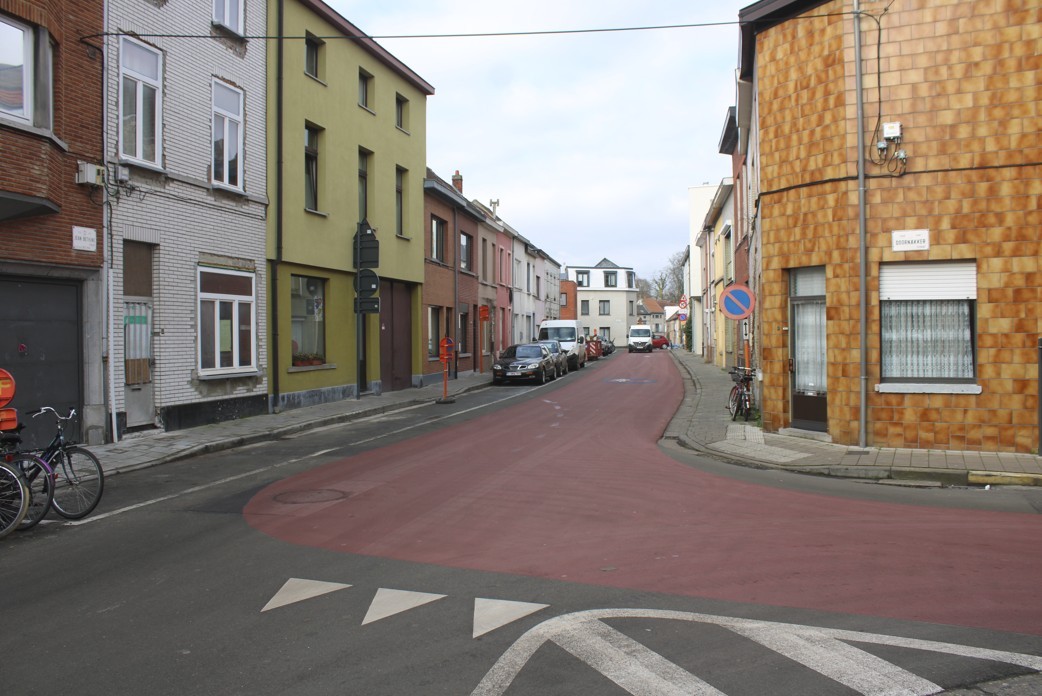
Priority from the right is one of the most common parts of the category B theory test in Belgium — and one of the most misunderstood. Many candidates know the basic rule but lose marks on scenario questions as soon as exceptions come into play.
In this article you get a complete, fact-checked overview of the priority rules: the basic rule, all official exceptions by category, the special cases the test deliberately checks, and a systematic approach to intersection questions.
Short answer: when does priority from the right apply? • At ALL intersections without traffic signs, traffic lights or instructions from an officer • Regardless of the width, importance or visibility of the road • The basic rule is set out in article 12 of the Belgian Highway Code |
What is priority from the right?
Priority from the right means that, as a driver, you are required to give way to any vehicle coming from the right at an intersection where no other rules apply. This is literally stated in article 12 of the Belgian Highway Code: 'Every driver must give way to the driver coming from the right.'
Crucially: the width, congestion or importance of a road plays no role at all. A car on a narrow street has exactly the same right to priority at an unregulated intersection as a car on a wide road — if it is coming from the right. This is the most common mistake made on the category B theory test.
When exactly does priority from the right apply?
Priority from the right is the default rule — it always applies unless another rule replaces it. Specifically, it applies when:
• There are no traffic signs regulating priority (B1, B5, B9, B15)
• There are no traffic lights present or they are not working
• No officer or authorised person is giving instructions
• No specific exception applies (see below)
⚠ The most common mistake: 'big road = priority' At an unregulated intersection without signs, priority from the right always applies — even if you are driving on a wide, busy road and the traffic from the right is coming from a narrow street. The width or importance of the road does not count. Only the position (from the right) and the presence of signs determine it. |
Priority order: what takes precedence over priority from the right?
The Belgian Highway Code uses a clear order of priority. If a higher rule is higher up the list, it completely replaces priority from the right:
Priority | Rule | Example |
1 — Highest | Instructions from an officer or authorised person | Officer directing traffic with arm signals |
2 | Traffic lights | Red light = stop, regardless of who is coming from the right |
3 | Traffic signs | B1 (give way), B5 (stop), B9 (priority road), B15 (give way to all drivers) |
4 | Road markings | Give-way triangles = give way to anyone crossing the marking |
5 — Standard | Priority from the right | Applies when nothing else is specified |
All exceptions to priority from the right
Exception 1 — Traffic signs regulate priority
When one of the following signs is present, it completely replaces priority from the right:
Sign | Meaning | Effect on priority from the right |
B1 (inverted triangle) | Give way to all traffic | You must give way — priority from the right no longer applies |
B5 (stop sign) | Stop and give way | Same as B1, but you must also come to a complete stop |
B9 (yellow diamond) | You are on a priority road | You have priority over all traffic crossing the road |
B15 (yellow diamond with white border) | End of priority road | Priority from the right applies again |
B17 (arrow) | Announcement of end of priority road | Next intersection: priority from the right applies again |
Important: the B9 sign must be repeated after each intersection. Is there no new B9 sign after an intersection? Then the priority road no longer applies and priority from the right comes into force again.
Exception 2 — Roundabouts
At most roundabouts in Belgium, a specific priority rule applies: anyone who wants to enter the roundabout must give way to anyone already on it. This is indicated by the D5 sign (blue arrows in a circle) on the roundabout itself and B1 or B5 on the access roads.
⚠ Exception: not all roundabouts are the same Not every roundabout has a D5 sign. If there is no D5 sign and no B1 on the access roads? Then the normal priority rules apply — including priority from the right. Always check which signs are present before you choose an answer. |
Exception 3 — Trams and priority vehicles
Trams always have priority in Belgium, regardless of whether they come from the right or the left. Priority vehicles (police, ambulance, fire brigade) with flashing lights and siren also always have priority — but they themselves are still required to drive carefully.
• Tram: always has priority, even from the left — this is a classic exam trap
• Bus leaving a stop in a built-up area: has priority when the left indicator is switched on
• Priority vehicles (flashing light + siren): always have priority — but drivers remain obliged to be cautious
Exception 4 — Cyclists on cycle paths
Cyclists on a cycle path with white parallel lines (marked cycle path) always have priority when you cross that cycle path — even if the cyclist comes from the left. This also applies when there are no other signs present.
Common exam mistake: cyclist from the left Many candidates think: the cyclist is coming from the left, so I have priority. Wrong. A cyclist on a marked cycle path with white lines always has priority when you cross that path — regardless of direction. This is a deliberately placed trap on the category B theory test. |
Exception 5 — Motorway and dirt track
• Entering a motorway: anyone entering the main carriageway of a motorway via an acceleration lane must always give way to moving traffic
• Dirt track or path: anyone leaving a dirt track or path onto a public road must always give way — even if the other vehicle comes from the left
• Leaving a private driveway or car park: anyone leaving a private driveway, car park or site has no priority
Systematic approach to intersection questions on the theory test
Intersection questions are the hardest questions on the category B theory test. Most mistakes happen because candidates skip one element. Use this fixed order for every intersection question:
Step | What do you check? | What are you looking for? |
1 | Officer or authorised person present? | Arm movements, whistle, baton — always follow them |
2 | Traffic lights present? | Red, amber, green — including arrow lights |
3 | Traffic signs present? | B1, B5, B9, B15, give-way triangles — also in the background |
4 | Tram present? | Tram always has priority — regardless of direction |
5 | Cycle path present? | Marked cycle path = cyclist always has priority when crossing |
6 | None of the above? | Priority from the right — look at all vehicles coming from the right |
Golden tip: always scan the full image Signs, give-way triangles and trams are deliberately placed in the background or at the edge of the image. Anyone who only looks at the central intersection misses the detail that determines the answer. Always take 2-3 seconds to scan the full image before answering the question. |
Typical pitfalls in priority questions on the theory test
• Greater road = priority: Completely wrong. Width does not matter. Only signs and position (from the right) count.
• Going straight = priority: Wrong. A vehicle going straight does not automatically have priority. Priority from the right also applies to vehicles going straight on.
• Roundabout always gives priority to those already driving: Not always. Only with D5 sign + B1 on access roads. Without signs: normal rules.
• Tram from the right = priority from the right: No. Trams always have priority, even from the left.
• Cyclist from the left = no priority: Wrong on a marked cycle path. A cyclist on a marked cycle path always has priority when crossing.
• B9 sign always continues to apply: No. B9 must be repeated after every intersection. If there is no new B9? Then it no longer applies.
Practise priority questions at exam level with RAPP With RAPP you practise the category B theory test with realistic intersection questions at GOCA level. Automatic mistake analysis by topic shows you where you go wrong on priority questions — so you never make that mistake again. |
Frequently asked questions (FAQ)
When does priority from the right apply in Belgium? Priority from the right applies at all intersections without traffic signs, traffic lights or instructions from an officer. It is the default rule — it always applies unless a higher rule replaces it. |
Does a larger road automatically have priority? No. The width or importance of a road plays no role at all. Only the presence of signs and the position (from the right) determine priority. |
Does a tram always have priority in Belgium? Yes. Trams always have priority — even when they come from the left. This is a classic trap on the category B theory test. |
Does priority from the right apply on a roundabout? Not if there is a D5 sign on the roundabout and B1 or B5 on the access roads. Then the vehicle already on the roundabout has priority. If those signs are not there? Then the normal priority rules apply. |
Does a cyclist always have priority at an intersection? A cyclist on a marked cycle path with white parallel lines always has priority when you cross that cycle path — even if the cyclist comes from the left. |
Does a B9 sign (priority road) apply continuously? No. B9 must be repeated after each intersection. If there is no new B9 sign after an intersection? Then the priority road no longer applies and priority from the right comes into force again. |
What is the difference between B1 and B5? Both require you to give way to all traffic. The difference: with B5 (stop sign) you must also come to a complete stop, even if there is no traffic. With B1 (inverted triangle) you only need to stop if there is traffic. |
Conclusion
Priority from the right is the default rule at unregulated intersections in Belgium — but the exceptions are just as important. Trams always have priority. Cyclists on marked cycle paths too. Roundabouts have their own rules. And a B9 sign does not last forever.
Those who work systematically — check signs, look for trams, check the cycle path, then apply priority from the right — lose no more marks on the most common category of the category B theory test.
Read also
• Trick questions on the category B theory test: 8 types with examples
• Common misconceptions about traffic rules on the category B theory test
• Most common mistakes on the category B theory test in Belgium
• How many mistakes may you make on the category B theory test?
• Practise the category B theory test: this is how you pass faster
Written by Daan Van Isterdael, co-founder of RAPP. He built the platform that helps more than 10,000 Belgian candidates pass their driving licence test.