
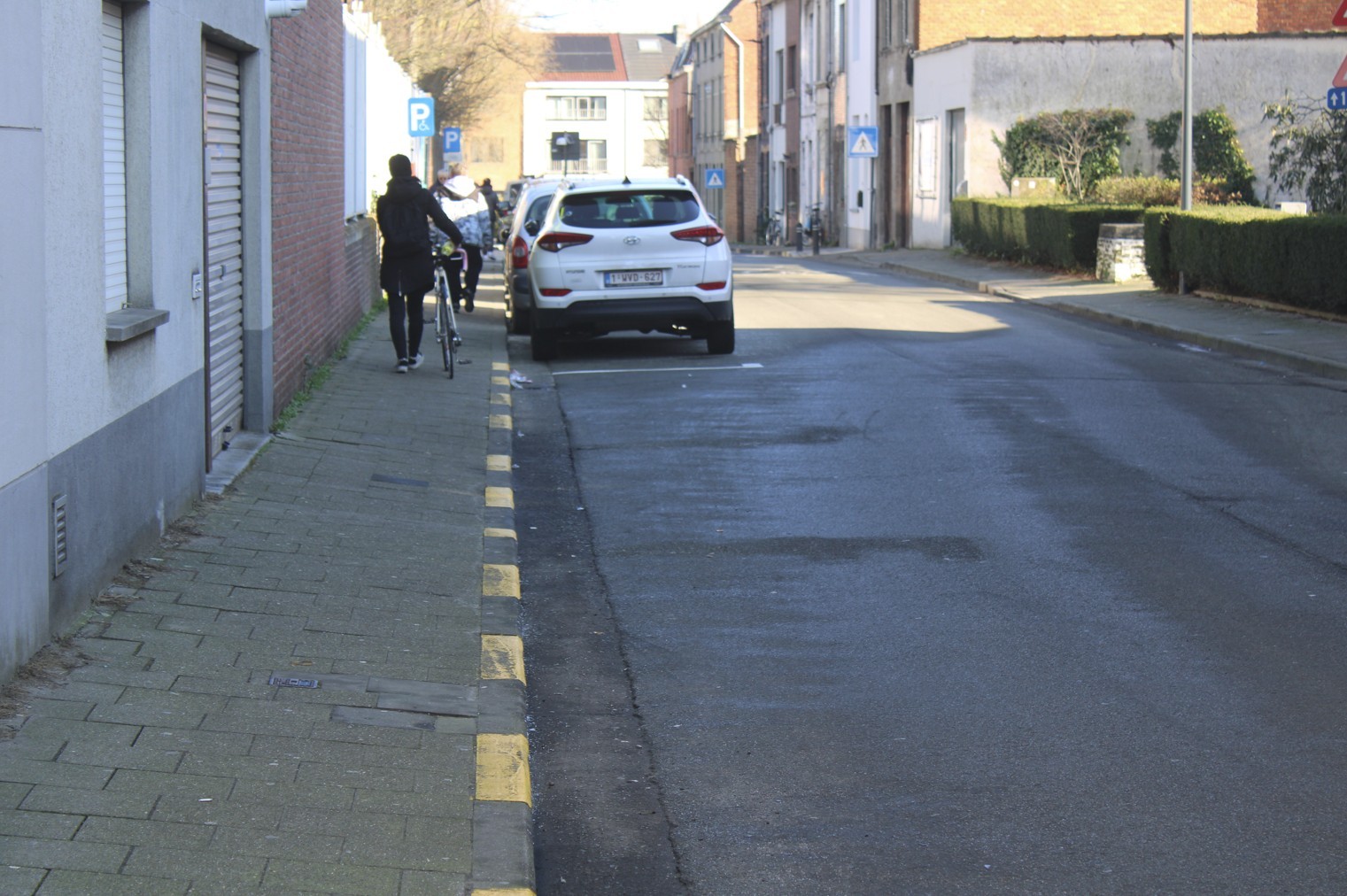
Parking rules are among the most underestimated parts of the theory test for driving licence B. Many candidates think parking is easy — but lose points because of concrete distance rules, the difference between E1 and E3, and the details of the blue zone they do not know well.
In this article, you get a complete and fact-checked overview of all parking rules in Belgium that are tested in the exam — including the exact distances, sign numbers and the most common exam traps.
Stopping vs parking: the crucial difference
This is one of the most tested distinctions on the theory test for driving licence B. Many candidates systematically confuse the two concepts.
Concept | Definition | Driver present? |
Stopping | Temporary stop — letting someone get in or out, or loading/unloading quickly | Yes — remains available |
Parking | Leaving the vehicle without immediate need | No — leaves the vehicle |
E1 vs E3: parking prohibition or stopping prohibition?
This is the most tested sign knowledge in parking questions on the theory test for driving licence B.
Sign | Name | What is prohibited? | What is still allowed? |
E1  | Parking prohibition | Parking prohibited | Stopping to drop someone off is still allowed |
E3 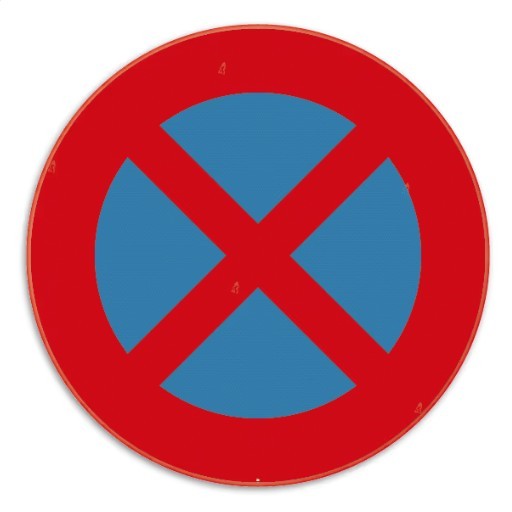 | Stopping prohibition | Parking AND stopping prohibited | Nothing — even a brief stop is forbidden |
The most common exam mistake: confusing E1 and E3 E1 (red line) = parking prohibition — you may still stop briefly to drop someone off. E3 (red cross) = stopping prohibition — everything is forbidden. This difference is deliberately tested in the exam. Always pay attention to the sign number and to the exact question: are they asking about 'parking' or about 'stopping'? |
Where may you not park in Belgium? (with exact distances)
The Belgian Highway Code contains concrete distances for parking prohibitions. These are the most tested distance rules on the theory test for driving licence B:
Location | Prohibition | Exact distance |
Junction | No parking | Within 5 metres of the edge of the transverse carriageway |
Pedestrian crossing | No parking | On the pedestrian crossing and within 5 metres before it |
Traffic light at a junction | No parking | Within 20 metres before the light |
Traffic light outside a junction | No parking | Within 20 metres before the light |
Bus stop | No parking | Within 15 metres of the stop |
Bus or tram stop (sign) | No parking | At the stopping place itself |
Entrance/exit | No parking | In front of it |
Pavement | No parking | Unless signage explicitly allows it |
Cycle path | No parking | Completely prohibited — no exceptions |
Priority road outside built-up area | No parking | On the carriageway itself |
Raised level crossing | No parking | On the level crossing itself |
⚠ The 5-metre rule at junctions — the most underestimated distance Not 'right by' or 'near' a junction — but specifically less than 5 metres from the extension of the nearest edge of the transverse carriageway. This is a fixed exam question. Remember: 5 metres at a junction, 5 metres before a pedestrian crossing, 20 metres before traffic lights, 15 metres before a bus stop. |
The blue zone: rules and parking disc
The blue zone is a classic topic on the theory test for driving licence B. Here are all the rules correctly and completely:
• When does the blue zone apply?: On every working day, including Saturday, from 9 am to 6 pm — unless the supplementary plate states other times
• Maximum parking time: 2 hours
• Parking disc mandatory: Yes — must be clearly visible behind the windscreen
• Set arrival time: Round up to the next half-hour. Arrival at 10:05 → parking disc at 10:30 → you may stay until 12:30
• Adjusting the parking disc is forbidden: Going back to move the disc counts as fraud (offence of the first degree, €58 fine)
• False arrival time: Forbidden — this is also fraud
Recognising the blue zone The blue zone is indicated by the E9 sign (parking zone), supplemented by a supplementary plate showing a parking disc. The zone applies until a new sign or until the next junction. If there is a P sign for a specific parking space, you may park there without limit without a disc — unless the sign itself mentions a disc. 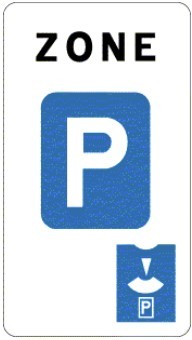 |
Parking in a home zone
In a home zone, strict parking rules apply that are often forgotten in the exam:
• You may only park in designated places
• Maximum speed in a home zone: 20 km/h (not 'walking pace')
• Pedestrians have priority everywhere — even on the carriageway
• Playing is allowed on the carriageway
Parking on the pavement: when is it allowed?
The basic rule is clear: parking on the pavement is prohibited. But there is an exception that is tested in the exam:
• Prohibition: Parking on the pavement is, in principle, prohibited
• Exception: When signage explicitly allows it (sign or marking)
• Pedestrians: At least 1.5 metres of clear passage for pedestrians must always remain
• Verge: On a verge alongside the road, at least 3 metres must remain clear for through traffic
Common mistakes in parking questions on the theory test
• Confusing E1 and E3: E1 = parking prohibition (stopping still allowed), E3 = stopping prohibition (everything forbidden)
• Underestimating the junction distance: It is 5 metres — not 'right by' or 'as close as possible'
• Forgetting the blue zone time: Applies from 9 am to 6 pm on working days and Saturday — not on Sunday
• Forgetting to round the parking disc: Arrival at 10:05 → disc at 10:30, not at 10:05
• Thinking the pavement is always prohibited: There is an exception with explicit signage
Systematic approach for parking questions on the theory test
Use this fixed order for every parking question:
Step | What do you check? |
1 | Are there traffic signs? (E1, E3, E9, blue zone, resident parking) — also in the background |
2 | Am I too close to a junction? (less than 5 metres?) |
3 | Am I too close to a pedestrian crossing? (on or within 5 metres?) |
4 | Am I too close to a traffic light or bus stop? (20 m / 15 m?) |
5 | Is there a cycle path, pavement or entrance? Are they clear? |
6 | What exactly is the question asking: 'parking' or 'stopping'? |
Practise parking questions at exam level with RAPP With RAPP, you practise the theory test for driving licence B with realistic parking situations at GOCA level — including E1/E3 recognition, distance questions and the blue zone. Automatic error analysis shows you where you go wrong. |
Frequently asked questions (FAQ)
What is the difference between parking and stopping? Stopping is a temporary stop while you remain available — to let someone get in or out, or to load something quickly. Parking is leaving your vehicle without immediate need. The difference determines whether an E1 or E3 sign applies. |
What is the difference between E1 and E3? E1 (red line) = parking prohibition. Stopping is still allowed. E3 (red cross) = stopping prohibition. Everything is forbidden — even stopping briefly to drop someone off. |
How many metres from a junction may you not park? Within 5 metres of the extension of the edge of the transverse carriageway. This is a fixed exam question with a concrete distance — not 'right by'. |
May you park in front of your own entrance? No. You may not park in front of an entrance or exit — not even in front of your own driveway. |
How does the parking disc work in a blue zone? You round the arrival time up to the next half-hour. Arrival at 10:05 → disc at 10:30 → you may stay until 12:30. The blue zone applies on working days and Saturday from 9 am to 6 pm, unless the supplementary plate states other times. Maximum 2 hours. |
May you park on the pavement in Belgium? In principle not. Exception: when a traffic sign or marking explicitly allows it. At least 1.5 metres of clear passage for pedestrians must always remain. |
How fast may you drive in a home zone? Maximum 20 km/h — not 'walking pace'. In a home zone, you may only park in designated places and pedestrians have priority everywhere. |
Conclusion
Parking rules in Belgium are more concrete than most candidates think: exact distances (5 m at a junction, 5 m before a pedestrian crossing, 20 m before lights, 15 m before a bus stop), specific sign numbers (E1 vs E3) and the blue zone rules with the parking disc. Whoever knows those details and analyses them systematically will no longer lose points on parking questions.
Remember: the question 'parking' or 'stopping' makes all the difference. Read every question twice.
Read also
• Common thinking mistakes about traffic rules on the theory test for driving licence B
• Speed limits in Belgium for driving licence B: complete overview by region
• How many mistakes may you make on the theory test for driving licence B?
• Theory test driving licence B practice: how to pass faster
Written by Daan Van Isterdael, co-founder of RAPP. He built the platform that helps more than 10,000 Belgian candidates pass their driving licence test.